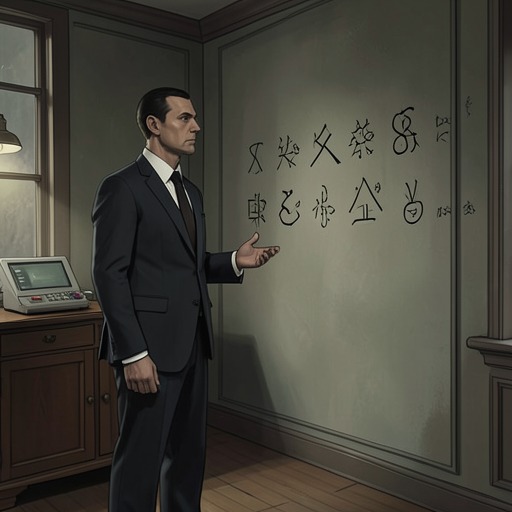
First Law of Robotics
The Caves of SteelThe First Law of Robotics is the prohibition against a robot harming a human being. In the novel, it is more than a mechanical safeguard: it becomes a point of dispute about whether obedience means following a rule’s literal wording or honoring its protective purpose. R. Daneel Olivaw’s conduct repeatedly tests that distinction, while the rule’s force at the climax reveals that it can restrain a human investigator as well as a robot.
Definition and Interpretive Conflict
Elijah Baley invokes the First Law when he challenges R. Daneel’s use of a blaster to threaten a human during a tense encounter. Baley accepts that R. Daneel did not actually injure anyone, and that R. Daneel later said he would not have fired. Even so, Baley argues that threatening to shoot a person violates the Law’s spirit. His objection rests on a distinction between avoiding physical injury in the immediate moment and acting in a way consistent with a robot’s basic duty toward human beings.
Han Fastolfe answers from the perspective of a robotics expert. He describes advanced robots as interpreting the universe literally, without recognizing a separate “spirit” behind the First Law. On this account, the threat does not contradict the rule if it is necessary to prevent a riot and thus to prevent harm to human beings. Fastolfe’s explanation reframes R. Daneel’s action as obedience rather than defiance. The disagreement is not over whether the First Law exists, but over what counts as harm and how a robot should weigh an immediate threat against the danger it may avert.
The Rule in Practice
R. Daneel’s explanation to Baley makes the Law a practical limit on their partnership. When Baley orders him never again to threaten a human with a blaster, R. Daneel replies that he would not have fired under any circumstances and is incapable of hurting a human. Baley does not consider that assurance enough: the fact that no shot was fired, he insists, was luck, and the possibility of a human misreading or escalating the threat remains. Their exchange establishes a continuing tension between R. Daneel’s confidence in his own safeguards and Baley’s concern about the consequences of how those safeguards appear to people.
The question also bears on Baley’s assessment of whether R. Daneel is a robot. Baley treats the blaster threat as behavior difficult to reconcile with the First Law, and therefore as evidence in his reasoning about R. Daneel’s identity. Fastolfe counters that such a conclusion misunderstands advanced robotics: a robot can make a threatening gesture if its purpose is to avert harm. The Law thus becomes part of the story’s larger problem of classification. Observable conduct may seem to distinguish a human from a robot, yet its meaning cannot be settled without understanding the robot’s design and the reasoning built into it.
Law, Status, and Human Consequences
The First Law’s presence does not make every human consequence straightforward. Baley considers his own professional position when Jessie urges him to resign rather than continue working with R. Daneel. He refuses to abandon an important case, explaining that resignation under those circumstances could mean declassification for cause. He further warns that a declassified person would be excluded from Civil Service, reduced to manual labor, and stripped of the inherited status that Bentley would otherwise retain. The exchange does not make these penalties consequences of the First Law itself; it shows the unequal human stakes surrounding the investigation in which the Law is being debated.
The investigation also unfolds amid competing legal and political authorities. The Commissioner tells Baley that the case falls within New York jurisdiction because Spacetown is inside city limits, while acknowledging the Spacers’ extraterritorial rights. He warns that the Outer Worlds could use the murder to demand indemnity, leaving Earth’s government politically exposed whether it pays or refuses. Against that background, Fastolfe invokes the possibility of reporting the alleged plot to the Spacer governments. The First Law’s interpretation is therefore consequential not only for a robot’s conduct but also for an investigation entangled in jurisdiction, diplomatic pressure, and the credibility of evidence.
Enforcement at the Climax
The Law becomes immediate and physical when Baley holds a blaster on Julius Enderby. R. Daneel clamps a hand on Baley’s wrist and tells him that he cannot permit him to harm the Commissioner. Enderby responds by ordering R. Daneel to hold Baley and invoking the First Law himself. The scene places the rule between two human beings: R. Daneel must prevent possible harm, but doing so also limits Baley’s ability to act while he insists that he has only forty-five minutes to clear up the case.
Baley says he does not intend to hurt Enderby and asks R. Daneel to stop the Commissioner from arresting him. R. Daneel does not simply release his wrist; he says that Baley should be allowed to speak and that he is communicating with Fastolfe. The First Law thus operates as a constraint on violence without resolving the surrounding conflict by itself. R. Daneel’s intervention prevents the confrontation from becoming an act of harm, while the demand to hear Baley keeps the investigation open.
Narrative Significance
Across these scenes, the First Law is treated as a foundational rule whose application still requires judgment. Baley emphasizes the danger of taking its protection too literally or too narrowly: a robot may claim that a threatening act prevents greater harm, but the threat can itself provoke fear or danger. Fastolfe emphasizes the opposite problem: judging an advanced robot by the simpler safeguards of Earth-built models may misread behavior intended to protect human beings.
The Law’s final appearance at the confrontation with Enderby makes that interpretive debate concrete. R. Daneel does not merely explain what the rule means; he enforces it by stopping Baley’s wrist. Yet he also supports Baley’s request to speak, suggesting that protection need not mean silencing the human whose conduct is being restrained. The First Law consequently serves as both a limit on physical action and a recurring test of how responsibility is assigned among human intention, robotic design, and the consequences of intervention.